
The Eight Perceptions and Nine Cauldrons

The Eight Layers of Perception and the Nine Cauldrons
Section 1: Alaya, Alaya, where art thou, Alaya?
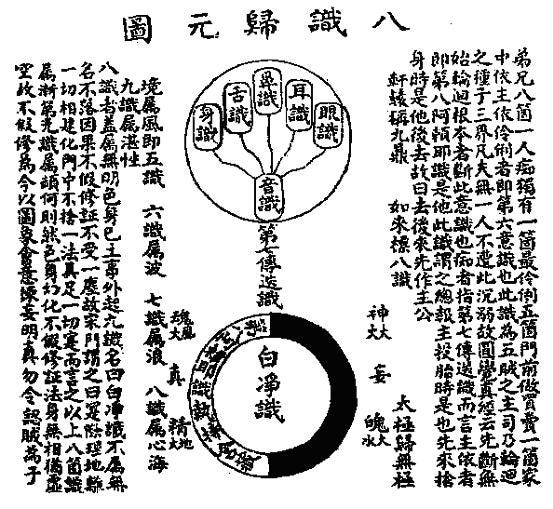
Image: “The Eight Perceptions Return to their Origin Image” is a key element of the text Xing Ming Gui Zhi which fuses Buddhist and Daoist ideas to form a coherent narrative about what we are trying to do with the cultivation of the Golden Elixir.
Daoism borrows many ideas from Buddhism, one of the most important being the concept of eight layers of perception which interfere with the ability to perceive our original nature.
In Neidan studies the eight layers are:
Alaya: the most original layer of consciousness which we do not perceive. This layer serves as our base consciousness and is inherited as a result of karma (It may also be possible to view this in a similar way to Jung's subconscious),
Transfer perception: this layer washes information back and forth between Alaya and the levels of perception we normally recognize such as thought,
The mind: the mind produces thoughts and controls the other regular senses,
The eyes: the eyes are associated with vision,
The ears: the ears are associated with hearing,
The tongue: the tongue is associated with taste and speech,
The nose: the nose is associated with smell,
The body: the body is associated with tactile sensation.
Xing Ming Gui Zhi says that the five senses of sight, smell, taste, touch, and hearing are like five thieves who are all brothers, but there is an older sixth brother who controls them all and that is the mind.
It is the mind that carries messages back and forth between Alaya via the transfer consciousness and the mind which acts on attachment and is bound by karmic affliction, so in that case it is the mind which has to be brought under control and subdued to stop it from causing us more suffering.
Xing Ming Gui Zhi doesn't stop there though, since the mind is not the deepest layer of our perception, instead the authors of that text believed that even the pre-heaven Alaya consciousness has to be subdued in order to reveal “the original face” which existed before you were born.
We'll touch on the solution to this problem in the Nine Cauldron's section of this article which is part of the subscriber only content, but let's first consider the implications of the eight layers of consciousness...
Old Daoist thinking says there are five senses, each associated with an organ, such as the taste and the heart, the vision and liver, smell and lungs, hearing and kidneys, speech and spleen.
This model accounts for the mental activities of perception, the masculine spirit, feminine spirit, will, and mind, as well as the emotions of joy, anger, sadness, fear, and pensiveness.
These are further added to by the spirit being associated with liver and heart, and essence being associated with lungs and kidneys, with the Qi being the domain of the Yin Yang activity of the mind (the Qi in Neidan can sometimes be viewed as the communication between the spirit and essence).
This theory accounts for post-heaven and pre-heaven ideas about inversion of Yin and Yang leading to the development of the medicine, but does not account for the period before the generation of the body. In classic Neidan books like Dao De Jing Chan Wei this is accounted for by the Dao creating nature and life, and nature and life being an ancestral feature of each of us, but Xing Ming Gui Zhi holds that nature and life exists at multiple levels including:
nature created as the beginning of the universe, life created as a product of nature,
nature and life being passed down ancestrally through each subsequent generation inheriting the nature and life of their parents,
nature and life being pre-heaven characteristics of human Jing and Shen,
nature and life being expressions of our temperament and inherited personality traits,
Xing Ming Gui Zhi makes the assertion that we should cultivate the deepest level of nature and life that come from the Dao and ignore the rest, but realistically speaking the practice actually starts at the level of mind and body which are post-heaven branches of the pre-heaven nature and life aspects of Jing and Shen.
This is one reason why Xing Ming Gui Zhi suggests we must account for the presence of Alaya and don't stop at the cultivation of the Jing and Shen aspects, since it is possible to practice Neidan at the pre-heaven level, achieve the basic medicine, circulate the small orbit, but not achieve the large orbit and beyond.
This happens as a result of not completely letting go of all images, so you can think of the Alaya and transfer perception as places where images are generated and received, then sent to the senses.
Ultimately we will not become enlightened or liberated until we can completely cut out this deepest subconscious aspect in our practice, so the function of the Neidan concept of the eight layers of perception/consciousness is to remind us not to stop at the level of cultivating Qi, and that we have to go all the way and achieve union with the great void and harmony with the Dao.
Section 2: The Nine Cauldrons:
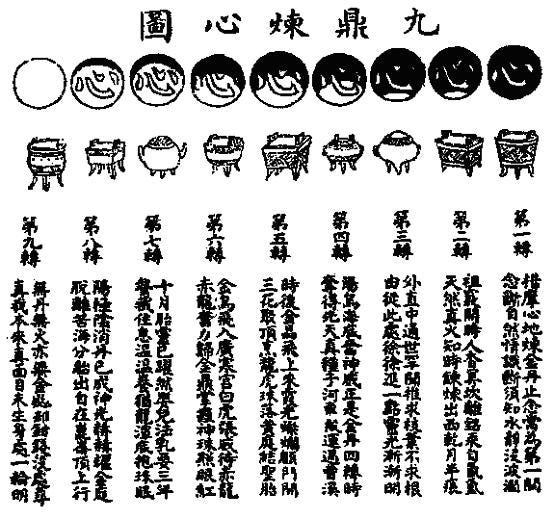
Image: the “Nine Cauldrons Image” explains to us the key details of spiritual development from pure Yin to pure Yang in nature and is an essential Neidan concept that everyone should know.